May 15, 2026
Digital signage for convenience stores is quickly becoming less about flashy technology and more about solving real operational challenges. In today’s convenience retail environment, pricing changes, menu updates, labor pressures, and customer expectations require retailers to communicate faster and more consistently than ever before. According to Brian Nelson, effective change management is less about adopting new technology and more about how leaders introduce and support that change with their teams.
Brian, a long-time leader in convenience retail technology, digital signage, and customer engagement solutions, recently shared his perspective during an industry conversation with loyalty and marketing expert Tom Bandy. Drawing from years of hands-on experience with independent operators, Brian explained why digital signage has become one of the most practical tools for retailers managing 20, 30, or even 50 locations – and why it’s true value lives at the intersection of operations and people.
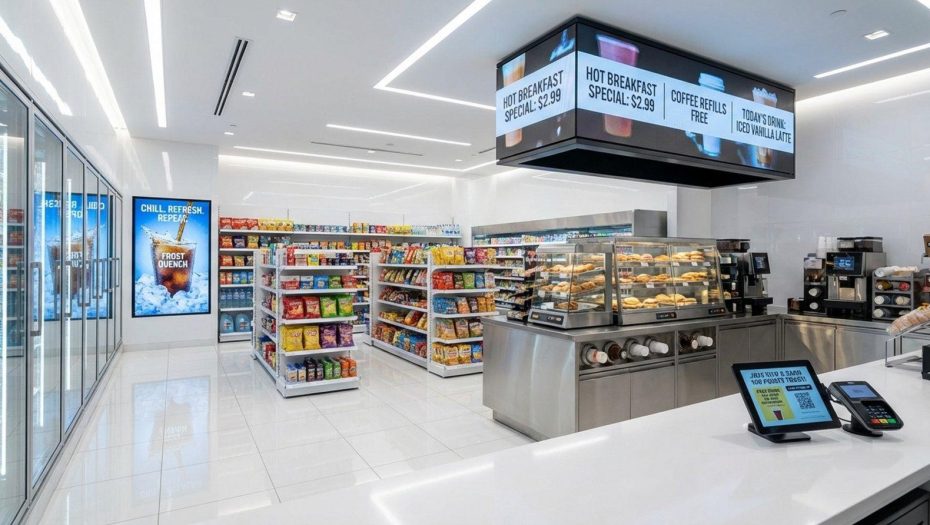
Meeting Modern Expectations with Digital Signage
Customer expectations have evolved. Today’s shoppers expect to encounter engaging, dynamic messaging throughout their journey- from the fuel pump to the sales floor. While digital displays are often perceived as a branding or “cool factor” investment, Brian emphasized that their real power is operational.
“There’s an expectation now that customers are going to be met with an engaging message and an engaging display,” Brian explained. “But prices are changing, menus are changing, promotions are changing – and store teams are stretched thin.”
Digital signage allows retailers to manage those changes centrally. Automated daypart transitions, real-time pricing updates, and coordinated promotions ensure information is accurate and delivered on time, every time- without relying on store employees to manually swap signage. When execution becomes more reliable, operational stress decreases and teams can focus on customer service.
A Crawl, Walk, Run Approach to Digital Signage
One of the most common barriers Brian hears from independent operators is fear – fear of complexity, fear of lacking creative skills, or fear of overwhelming already-busy teams. His message is consistent: don’t try to do everything at once.
“Don’t boil the ocean,” Brian advised. “Start in stages. Crawl, walk, run.”
That approach might begin by activating fuel pump screens that retailers already own, transitioning from printed menus to digital menu boards, or adding a simple display near a fountain or coffee station. Each step delivers measurable value while building confidence and organizational readiness for what comes next.
Importantly, Brian explained that retailers don’t need Hollywood-level production know-how to succeed. “This isn’t Scorsese,” he said. “We’re not trying to create the next Academy Award-winning picture. We’re taking the print POP you already use today and animating it.”
Brian emphasized that retailers do not need to navigate digital transformation alone. Companies like Shep Digital Solutions help convenience retailers take a practical crawl-walk-run approach to digital signage implementation, focusing on operational improvements before large-scale rollouts.
Operational ROI of Digital Signage for Convenience Stores
Brian consistently brings the conversation back to operational return on investment. Many convenience retailers already have digital screens across their properties, but those assets are often managed through separate systems tied to different departments. This fragmentation creates unnecessary complexity and resource drain.
“What we see all the time is retailers with different screens run by different systems,” Brian explained. “That’s when it feels overwhelming.
By consolidating fuel pump media screens, in-store menu boards, and promotional displays into a single, cloud-based platform, retailers can orchestrate a cohesive experience. Brian also pointed to the operational burden many retailers still face when updating menu boards manually across multiple locations. For a retailer with 30 stores, eliminating USB-drive menu updates alone can save hours of labor every week while improving consistency across every location.
He also pointed to the hidden efficiency gains. He described retailers still updating dozens of menu boards with thumb drives and added, “The amount of operational resource we can save by moving that to the cloud is immense.”
Building Customer Loyalty Through Community Messaging
Beyond efficiency and sales, Brian highlighted digital signage’s unique ability to strengthen community connections. Because content can change instantly, retailers can recognize local schools, sports teams, charitable partnerships, and community events in real time.
Brian shared an example that resonates deeply with independent operators: “If a mom pulls up to the pump and sees her daughter’s high school team congratulated on that screen—that’s generational loyalty right there.”
These moments reinforce a retailer’s role as a community destination, not just a transactional stop. Digital signage makes it possible to tell those local stories consistently in ways static print signage simply cannot.
Why Digital Signage Supports Store Teams
Brian’s philosophy on digital signage closely mirrors his broader leadership approach. Strong teams are built through respect, clarity, patience, and accountability. Leaders who explain the ‘why,’ remain visible, and involve their teams in the process earn long-term trust and buy-in.
Ultimately, Brian believes technology should remove friction, not add it. When introduced thoughtfully, digital signage supports store teams instead of overwhelming them—helping leaders guide change without burning people out.
Modernizing convenience retail does not require perfection. It requires clarity, consistency, and leaders who are willing to move forward one step at a time. When those fundamentals are in place, technology becomes an enabler of growth – not a burden.
Want to hear the full discussion with Brian Nelson? Watch the complete conversation here.
Related Resources
Retailers looking to improve customer engagement, labor efficiency, and operational consistency may also find these resources helpful:
- 7 Key Parts to C-Store Loyalty Systems
- Strategically Targeted Incremental C-Store Operations Enhancements
- C-Store Labor Maturity Model
Interested in exploring how digital signage, loyalty, and operational improvements can work together in your stores? Connect with the BandyWorks team to continue the conversation.